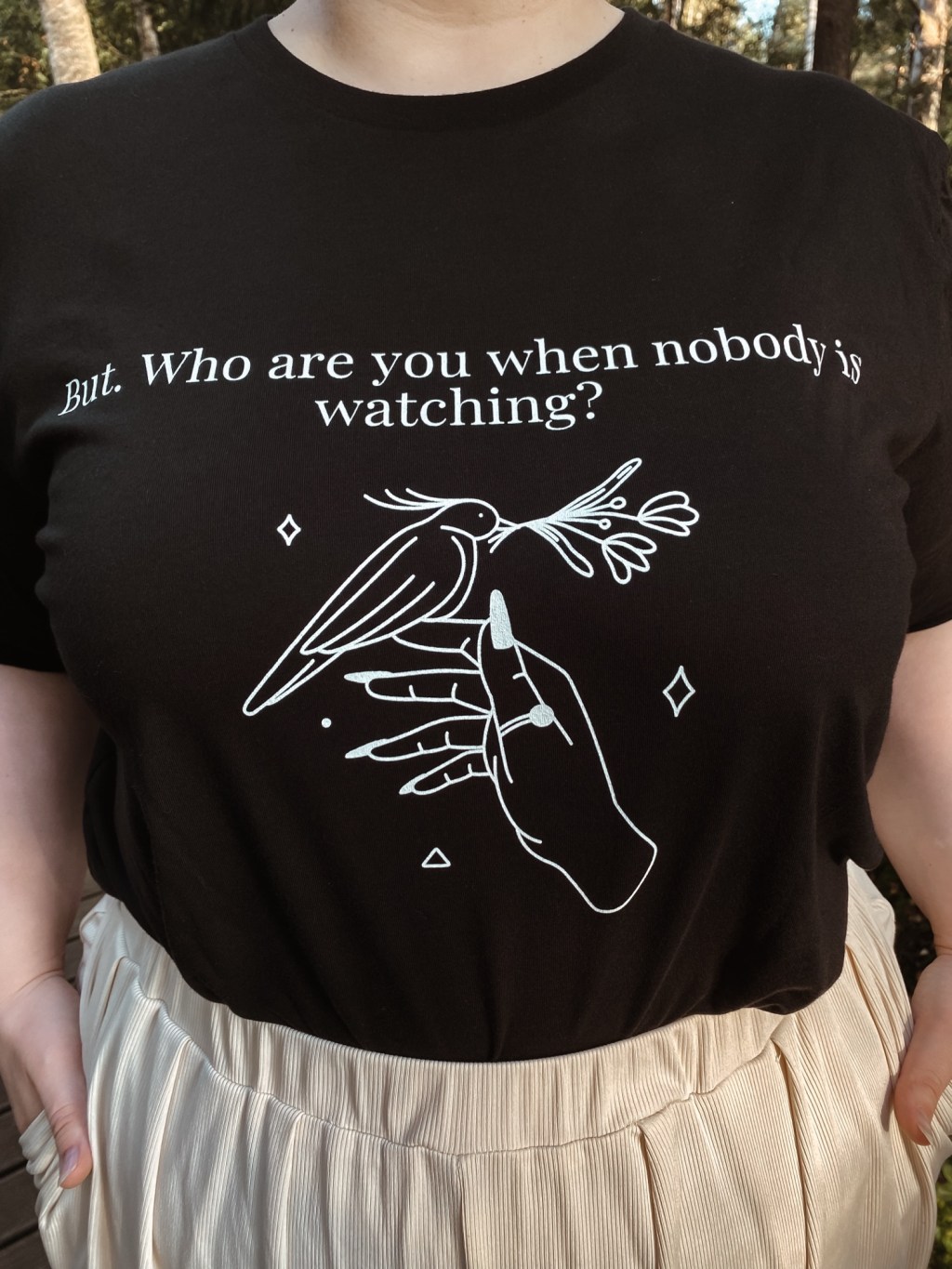
The Beginning: how Krapsakas clothing began
In Estonia, there is an expression: “a beautiful thing takes time”.
That phrase describes Krapsakas T-shirts and sweatshirts quite well.
4 years ago, in 2022, I felt called by the idea of designing T-shirts.
At the time, social media was flooded with ads like: “Make your own T-shirt store! I already did, and I earn tens of thousands a month!”
Making just another T-shirt store didn’t speak to me.
I didn’t want to put random products on sale just because it seemed quick.
I wanted meaning, thought, and purpose, a design that gives a person something extra beyond just a picture or text.
And that’s how the first Krapsakas T-shirts were born – still quite basic, but every journey has to start somewhere.
Why I didn’t want to “just” make a T-shirt store
From the beginning, it mattered to me that Krapsakas wouldn’t just be a place to buy clothes.
I was curious about what a person conveys through what they wear.
Do they express themselves? Say something without words?
Does someone notice it, and a conversation begins?
Back then, my main focus was “divine woman energy”.
When I explained it to strangers, nobody really got it.
I thought sincerely: “How hard can it be? Divine woman energy. Simple! No?”
It turns out that people who know you well may get you, but strangers might not understand right away.
The first designs and the first reality check
I made the first sample products to see if the designs actually worked on the clothing, and how the blanks* felt.
*Blank = T-shirt or sweatshirt with no design yet.
Looking at those very first designs today makes me smile 😄.
They are sweetly primitive.
Exactly how a beginning should be – experimenting, exploring, figuring out how an idea becomes a real product.
At the time, I thought it was perfectly normal. Later I understood that what looks good on screen doesn’t always translate in real life.
Some designs looked great digitally but felt off on a T-shirt. Some texts lost the feeling I wanted when printed.
That was my first reality check – “good design” doesn’t automatically mean good on clothing.
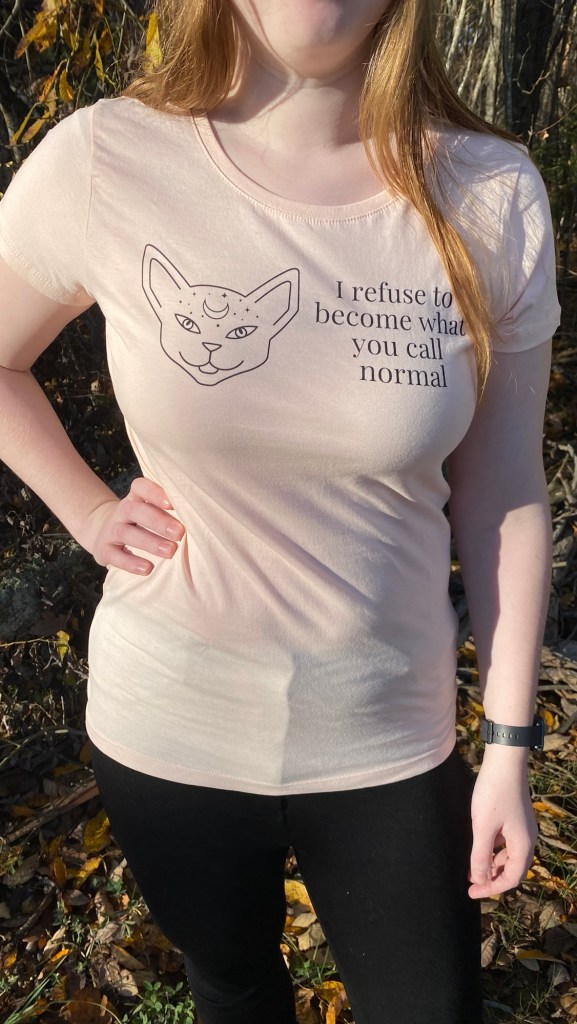
And in the same way, I quickly learned that “premium” doesn’t automatically mean quality.
You order something hoping it will be amazing, but in real life you look at it and wonder… how did this get the name premium?
This phase taught me one thing: having an idea isn’t enough.
If you want a genuinely good product, you have to test, compare, and honestly see what works.
What really worked and what didn’t
Making genuinely good products takes time.
It’s not: idea today, design tomorrow, sell the day after.
I can’t even count all the blanks, cuts, fabrics, and designs we tried. But there were many.
And it wasn’t just me – I had others wear, wash, use, and give feedback.
The first T-shirts were far from perfect – the fabric was see-through, prone to pilling, wrinkled easily, and the cut fit some bodies awkwardly, often turning into a crop-top look on women with larger chests.
It was a necessary lesson.
The premium myth
One of the more interesting discoveries was how deceptive the word “premium” can be.
For example, one T-shirt labelled as premium actually had much poorer fabric than another product that did not have the premium name attached.
This premium model released lint while being worn.
When I took the T-shirt off, the underarm area and bra area were full of small lint particles.
At the same time there were completely ordinary models that held up significantly better.
What makes a good T-Shirt
Through experimenting, wearing, washing and asking for feedback, it finally started to become quite clearly visible what actually makes one T-shirt a good T-shirt.
One important thing is fabric weight, meaning GSM.
In general 180 grams is a very good balance. It is not too thin nor too thick.
Krapsakas T-shirts are generally 180 grams.
175 grams can also work very well, but at that point much depends on the fabric composition.
200 and 220 grams are already quite strong material and are more suitable for wearing in cooler weather.
Grams play a bigger role than you might initially think.
For example, it affects whether the fabric falls nicely or somehow holds its shape too stiffly.
Also fabric with lower grams wrinkles significantly faster and loses its shape more easily.
A T-shirt with higher grams simply stays in shape better.
It is also important that the fabric consists mainly of cotton.
Cotton lets the skin breathe, generally does not irritate the skin and visually stays beautiful longer.
And then comes softness.
This was the place where premium and non-premium models surprised again.
A blank labelled as premium felt pleasantly soft in hand when the order arrived.
But after the first wash that softness disappeared.
At the same time another blank that did not have the premium name did not seem special at first, but after washing became much softer and also stayed very pleasant when wearing. And that softness did not disappear later either.
Print vs. Embroidery
When at first it seems that you simply choose a design and have it applied to the product, then actually the work only begins there.
I tested both embroidery and different printing variants.
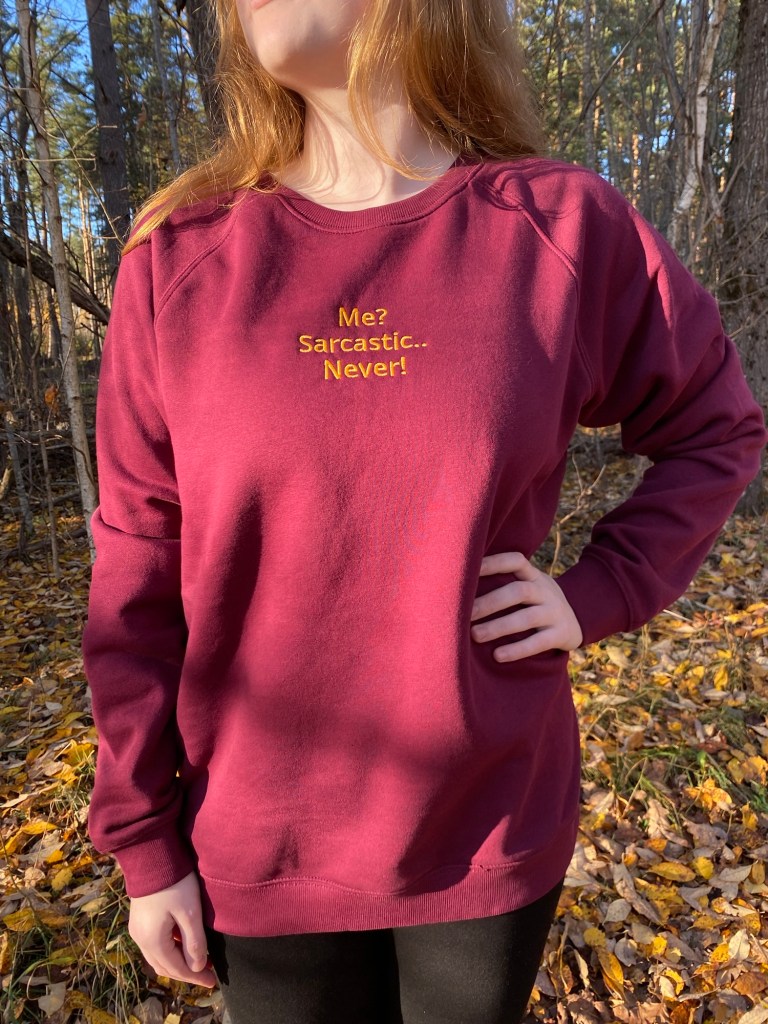
In the case of sweatshirts it became quite quickly clear that embroidery works much better than print.
Embroidery gives the message a stronger character and withstands time better.
I still have sweatshirts that were made as samples 4 years ago.
They have not been in weekly use, but they have had enough use and the embroidery still holds up very well.
In the case of T-shirts I thought at first that vinyl technique is definitely the best. It seemed visually effective. The print sits on top of the fabric and has a shinier finish.
But over time it started to peel off a little.
DTG print, where the colour goes into the fabric, turned out to be much more durable.
I had one T-shirt with which I confidently went for 2 years. The text did become a little duller with time, but it did not peel off.
And the fabric itself stayed very well, also the colour of the fabric.
What Krapsakas designs are meant to say
From the beginning, Krapsakas designs have carried meaningful messages.
I wanted people to be able to convey something through clothing.
Either express themselves without using words or create a conversation.
For example one design says: “I am on my “Unlearning modern life era”. What about you?”
This is more than just text.
It is a question that can make another person answer.
In a world where people feel more and more loneliness and where we often no longer know how to talk to each other, such sentences can be a completely unexpected beginning of a conversation.
Many Krapsakas designs are born from completely ordinary life.
For example one of the first designs came from when I was told: “I have seen many eye-rolling people in life, but I have not seen anyone roll eyes as much as you do.”
From this was born the text: “I’m sorry, did I roll my eyes out loud?”.
It fit perfectly.
Why Krapsakas chose slow fashion
Krapsakas is consciously a slow fashion brand. We do not do things in a hurry.
This reflects our principles and clearly shows that Krapsakas will not remain only a T-shirt and sweatshirts store – in the future, we will also offer products that follow the same principles.
All Krapsakas T-shirts and sweatshirts are made to order, which is important to us.
We do not want warehouses full of unsold items, because if they are not sold in time, they could end up in a landfill or polluting nature. Making products to order allows us to stay true to our values while ensuring each item is created with care.
Before a product goes on sale, it is preceded by a testing period. We also choose new designs only 4 times a year.
Often they are limited in time.
When a quarter ends, many designs disappear from sale and do not come back.
This keeps the selection fresh and gives each period its own face.
If you feel that Krapsakas resonates with you, you are welcome to explore the collection here.
The Road Ahead
In the case of Krapsakas it has been clear from the beginning that we do not do things in a hurry.
This means new designs do not come out simply because something needs to be added quickly.
Every new thing has to feel right.
By now several new designs are already ready and waiting for their time.
So there is something to expect.
Everything that has been done so far – the first primitive designs, tested blanks, wrong choices, good discoveries, different materials, printings, embroideries – all this has been a necessary part of this journey.
Because only this way can you truly understand what actually works.
Krapsakas is made thoughtfully.
We allow ourselves to experiment, make mistakes, rethink and make the next thing better.
Not because something would be wrong, but because a good thing is often born exactly this way- calmly, but consistently.
Krapsakas is a pleasantly mellow, slow-moving brand, always moving forward.
With love,
Krapsakas Agnes
Founder of Krapsakas


 ︎ “Buy me a coffee!” your opportunity to say thanks.
 .
.

 Krapsakas
Leave a comment